Emerging...


CADDO LAKE lies in eastern Texas and western Louisiana; it straddles the border. Folks named the town there Uncertain, because no one knew if it was in Louisiana or Texas. Uncertain is between, where my story lives too.

The story is a digital narrative relayed through an augmented reality interface. Augmented reality suspends graphics over the physical world through the means of an interface; in the case of my story, this interface is a mobile phone. This website is a reflection of the living and the doing that made this digital story.

Duck weed plant pods float along the water in a dotted green film. One July day, my step-brother thought the green, matted plant life so sturdy that he stepped off the end of the dock into the lake. The green ripples laughed at his miscalculation, but the ground appeared real to him.

the cultural immersion: my knowledge, literacy, and rhetorical understanding of the place—tangled bayous and knotted cypress, the pathways around the lake;

the literal moment of immersion that occurred while writing this narrative: the floodwaters that crept up the banks in March to levels unvisited in fifty years or more;

and the technological immersion: the virtual and augmented reality used to create the story and also relay the geographically bound narrative one thousand miles away in my adopted home of Colorado.

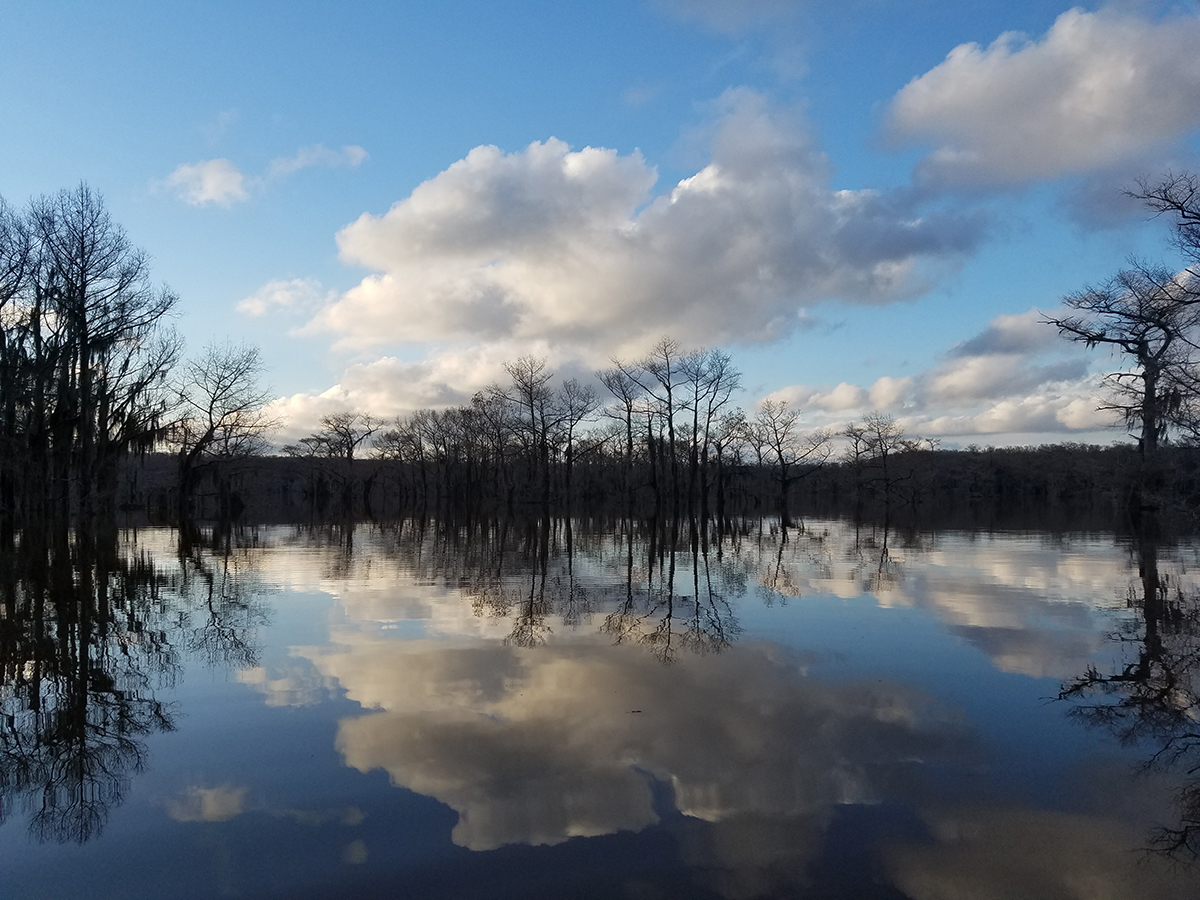
Reflection of a lake. Laura Price Hall.

Maps and Other Stories

In a map view of the lake, Caddo appears blue and neatly bounded, wide banks circling open waters. But maps are always fiction. Taking an aerial, satellite view, from overhead the dense cypress trees turn the whole lake from green to rust to grey with the seasons and all sense of the shape of the lake is lost in forested waters. On the water below, the green means that jet ski pilots, feeling the effects of afternoons full of Coors, might lose their way from the idyllic rope swings and clear waters of the river full of folks sunbathing on rafts and sliding off docks. They lose their way and arrive in the big lake via the bayou, where the murky water hides a 10-foot bed of moss and silt.

My neighbor, Don, gruff and pleasant, will yell for his dog, Whiskey, to stop barking off the end of the dock. Don will lumber to the dock and eventually call out to the lost jet skier, “Y’all alright?” and offer directions back to the recreational part of the lake more suited for jet skis.

When the cypress fade to rust-colored, huddled tree stands, the shooting begins. In the chilled October mornings, camouflaged hunters navigate the lake in moss-dressed boats. Ducks skim their feet across the water as they flee.

In winter, the sky and lake and spanish moss turn the same color gray, making it hard to tell which reflects the other.

The place, Caddo Lake, is fraught, as all places are, with competing narratives of place. It is livelihood, recreation, hunting ground, sacred homeland; colonized, historicized, re-historicized, mythologized, exoticized; exploited and protected.

I have but one story of the place, but there are others that can and should be told.
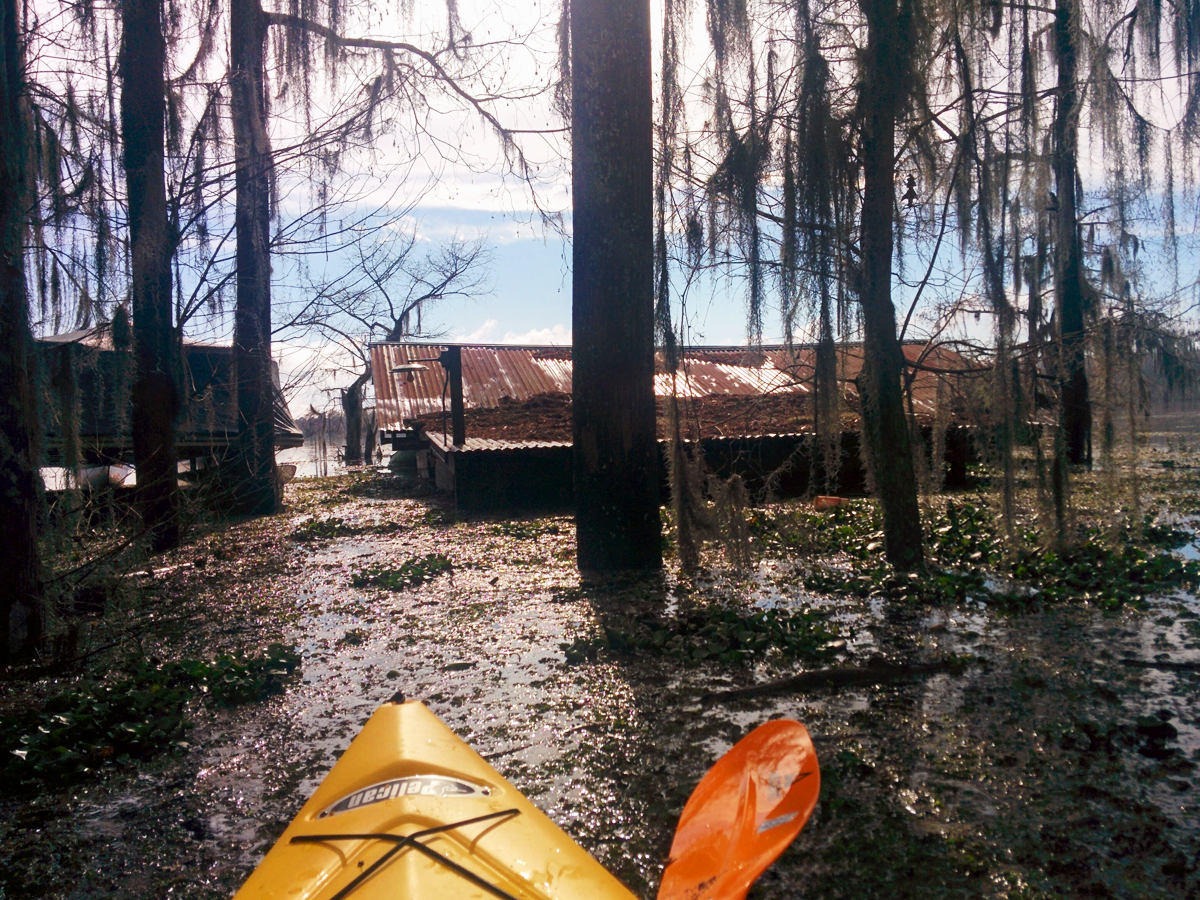
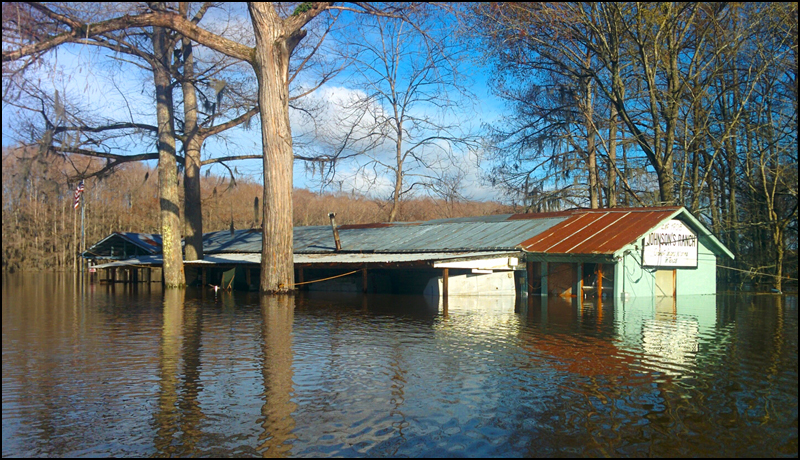
Flooded Boathouse. Laura Price Hall.

The Flood

On a Wednesday in March, my father sent me an email attachment of a photo of two boats bobbing next to the house, the house that he, his two brothers, and my grandfather built on the banks of Potter’s Point on Caddo Lake, high above the water. The photo showed it had been raining. This scene is not unusual for a lake house, but the proximity of the water in the picture arrested me—the water was a full 10 feet above the shoreline, approaching the house. And I held tickets for a week-long working “vacation” two days later.

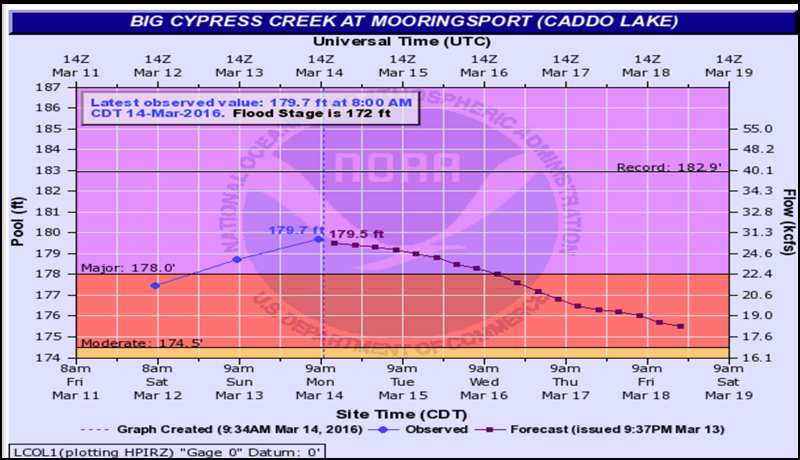
Flood stages at Caddo begin at 171.5 feet. By Friday, March 11th, 2016, the lake was at 177 feet and rising.

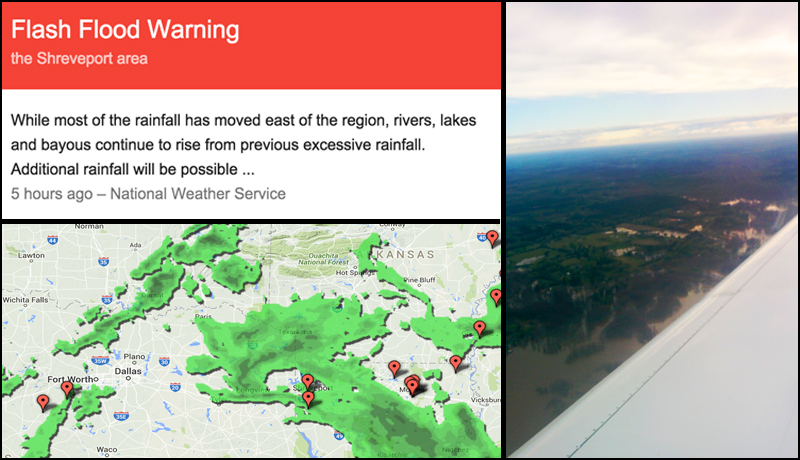
Amid news reports that many parts of Shreveport, Louisiana, the closest city about an hour away, was underwater, I boarded a flight from Denver to Shreveport.

The sound of at least thirty passengers’ phones receiving emergency warnings about the floods punctuated our touch down. I had observed the swollen waters from the air, crossing my seatmates’ personal boundaries from my aisle seat to see how far the bayou overflowed its banks. After a detour for a washed-out bridge across Jeem’s bayou on Louisiana Highway 2, I arrived at home, in the dark.


I flipped on the back porch light and illuminated Caddo, the lake now lapping against the lightposts and the deck steps--a dark, bobbing mass stretched out over what used to be the back yard. The neighbor’s barge creaked and moaned as it scraped against the trees and the roof of the boathouse.


We arrived on a Friday. Each day we checked the hydrology reports; each day, the hydrologists delayed the predictions of when the water would crest. By Monday, the waters immersed the basement of the house, crawling up the baseboards and onto the wall. Sloshing through the basement, I was able to get the guns out of the safe before my great-grandmother’s rifle was ruined by the water.

The flood filled our thoughts and conversations. Every object out in the yard became a marker for how high the water was relative to whatever other thing we used to measure the depth.


During the day, the lake was as quiet as I’d ever heard it. The flood warning and FEMA disaster protocols mandated that no motor boats could go onto the lake unless directly involved in rescuing people or belongings. Later, motorized boats were prohibited completely, as there were reports of looting in the evacuated homes farther down on the river.

Paddling was the only feasible way around.

But I preferred the lake at a paddler’s pace. As a kid, my two closest cousins and I would pile into the old wooden pirogue and argue for hours about who was squirming the most or was to blame for rocking the boat or steering into the trees.

This much higher on the lamp post; touching the bulb; over the cover. At the first step, over the third.
Live wells.

The in-breaking sunlight and a windless day compelled me to set down the theory books I was reading and set out to find the story of the place. I kayaked for hours to Government Ditch, so-named for the work done to provide a throughway from the Big Cypress River in Texas to the “Big Lake” that extends to Louisiana. The government that built “Government Ditch” carved out the channel to help move bales of cotton from the plantations of East Texas to Mooringsport, and later Shreveport via steamship. The ditch is both convenient and beautiful.

While I was paddling my kayak through government ditch, a man passed me in a motor boat and directed more than asked that I should grab the rope he’d throw to me and have him pull me wherever I needed to go. I responded in an equivocating politeness that I often forget I possess, in more of a southern accent than I usually have, that “I was fine.” I came here by choice from Potter’s Point, under my own power. I pointed to my waterproof notebook and my camera.


My story breaks me in. My body doesn’t belong here. Maybe my words do.


He moved on and I was alone again in the channel.

Lost in thought and the rhythm of paddling against a strong sideways current, I reflected on my digital narrative. What do we call these small pieces of a story? Are these vignettes? Are they akin to Italo Calvino’s incipits? Limited by character count, the texts I am writing appear to float above the place are brief, almost unnoticeable. It was in this last thought that I found my answer of what to call these texts.

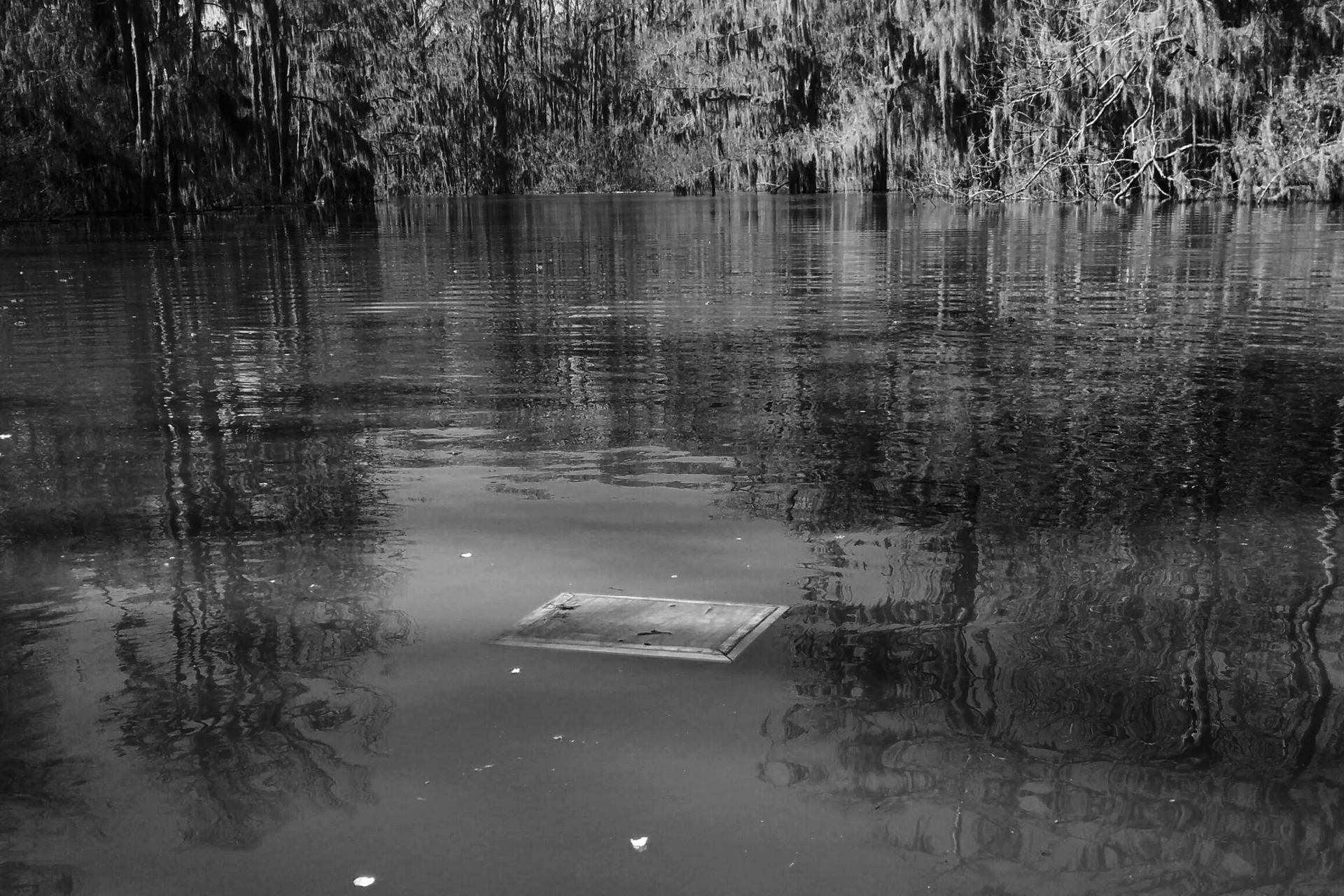
Something floating in the middle of the channel caught my eye. I kayaked closer and saw it was a frame. A frame! So pleased with the serendipity and feeling more “woo-woo” about the story finding me than I should have—as if the lake had decided to answer me directly—I attempted to grab the floating frame and pull it into the boat. On my first attempt the slippery molding eluded my grasp and the frame sank underneath the murky water. I thought I had lost it.

But the waterlogged object re-emerged and bobbed in the tea-stained water beside my kayak. Risking truly needing the long-gone boatman's assistance, I nearly toppled the kayak to pull the frame in the boat.

I spent the entire kayak trip home inundated with competing metaphors of the meaning of the frame in the lake. It wasn’t until I was on the plane back to Colorado, with the frame wrapped in cellophane and stashed away under the bulkhead in my checked bag (a bag that would be momentarily lost between missed flights from Dallas and Denver) that I realized my misidentification.

Why would a frame float in the water? It wouldn’t. As the plane hit turbulence while descending into Denver I realized this wasn’t a frame at all—but a live well, the top to a box-like reservoir built into fishing boats to keep caught fish alive and fresh for the ride back to the shore.

Live wells have depth. Live wells don’t hang flat in two dimensions.

I decided to call my texts that appear in my storyscape “live wells” to recall the found-object of the live well in the lake. Like the “frame/live well,” my stories are “found” on the lake by those who know where and how to look.

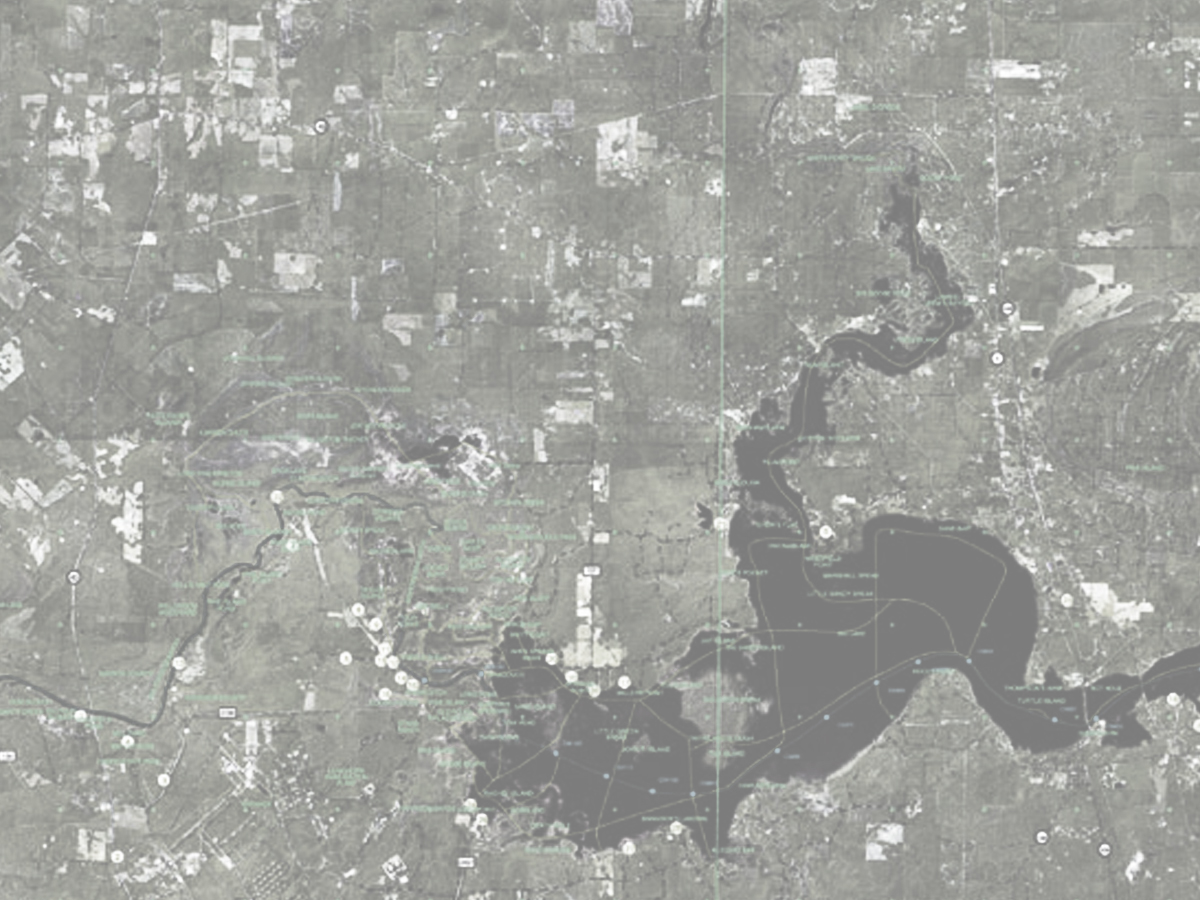
Aerial Map of Caddo Lake Boat Roads. USGS.
Uncertain

“What is it?” and “It’s creepy,” say my coworkers as they move my mobile phone around, pointing the phone’s camera to “places” where location tags allow GeoLayar, an augmented reality application, to associate various tweets and Instagram photos with the physical location where the authors uploaded their content; the application suspends the user-uploaded photos or tweets in space as the mobile phone’s screen acts as a lens to view the world around us. This “space” of a particular application of augmented reality, especially as it intersects with the material space of lived experience of users drives my inquiry about storying land and place.


When I was sixteen my father and I were headed home over water from Johnson’s Ranch, the only place to buy a soda or gasoline within thirty miles of the lake house, when we saw two women and two children in a boat whose motor sputtered in circles in the middle of the lake, far from the boat roads. The boat roads, marked by channel marks much like road signs, indicate the places on the lake safe for passage. Boat lanes are clear from the stumps that hide just below the water. As we approached the boat, we called out asking if they needed help. The women's Eastern European accents stood out in a space where speech is usually conducted with a thick, slow drawl. We towed them to the house, fixed the boat, and all had a lively dinner together before they returned to their bed and breakfast, now with better directions than from the folks who rented them the outboard motor. In adolescent philosophizing, I began to think about who belonged on Caddo and what and who was other there.


The conversation about augmented reality (AR) with my coworkers occurred over a thousand miles away from Caddo. My memory of the place no more tangible than flickering geographic data points miles away. My imagining of the place itself is as abstract as the maps of the place.


The word is absent; the word stands in. The “lake” means the house, the barge, the dock, the lake itself, the summer activity, the winter meeting place, the phone number I could dial without thinking, the near-death experiences, the hoary life-lessons, the manufactured nostalgia (the real nostalgia), the old patio and what’s growing on it now; the water, the cypress, the crossing boat roads. A freshness in the air in mid-January. You see everything but the word.


The map stands in, as the word stands in, as a construction to represent the place. In Google Maps, I center Caddo Lake in the screen, noticing the dashed border cutting the ghost-shaped lake in half. I toggle between “map view” and “satellite view” and watch the trees appear and disappear. I see the dashed lines of the border and remember the times my friend Hannah and I crossed the border into Louisiana to Big Sandy Island without knowing where the borders were.

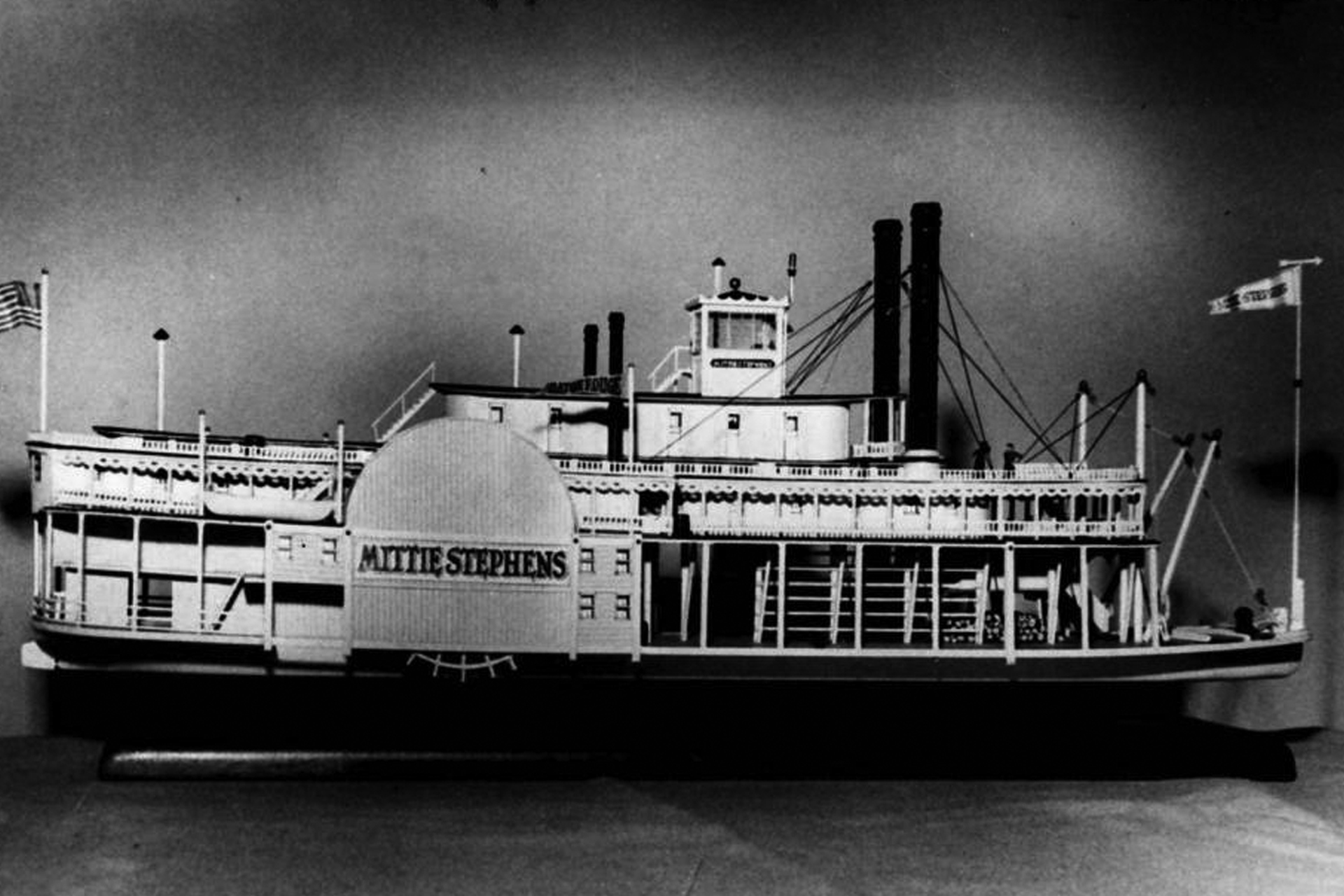
Replica of the Mittle Stephens. Jefferson Carnegie Library.
Shipwreck

It was this same fiction of space and boundaries that left archeologists, anthropologists, folklore-tellers, local newspapers, and my family enraptured by the mystery of a the sinking of the the Mittie Stephens steamer in February of 1869 (“The Mittie Stephens”, 1965).

Some say the Mittie Stephens caught fire and sank just off the northern bank of the lake in Texas; others are certain it occurred further east, towards Mooringsport in Louisiana. The story my family told was that it sank off of Swanson’s Landing on the Texas side. And like any good shipwreck story, folks spread rumors that there was gold in the wreckage. Gold from the cotton industry or the timber industry. Spanish gold shipping up from Mexico. Gold for the payment of confederate soldiers. Gold captured from the Union Army! My grandfather’s explanations changed with each telling, which is why I was unsurprised to see my great-grandfather’s colorful oral history quoted in a master’s thesis I encountered about the wreck. I.B. (Irwin Boger, “Bogey”) Price was quoted as saying he’d found a Flemish pistol from the wreckage on the shoreline (Lang, 1986).

When I told my father that this narrative made it into my digital narrative of the place, he paused and said somberly, “now you know…” In my misplaced anxiety, I assumed he was about to caution me to get permission from the family first. As if my father had somehow tapped into the anxiety that passes in conversation between my academic cohort and me about IRB proposals. He continued with sincerity, “you know that Old Bogie never let the truth get in the way of a good story,” he warned. I felt relief.

I reflect the uncertainty of place and story in my own storyscape. The GPS calibration in my mobile phone lacks the precision for recording exact latitude and longitude—the details needed to “place” my live well texts in the storyscape. Where the data point actually shows up will vary from device to device, from person to person. But it’s close enough to get the story across—”don’t let the data points get in the way of a good story,” I imagine I.B. would tell me before launching into the time he and his friends swam out to the wreck site and touched the stacks of the sunken Mittie Stephens with their feet (Lang, 1986).

My words, like memories, like places, like geo-data, are less accurate than I pretend they are. They live somewhere between reality and fiction, augmenting the world I experience with what I know or what I see.