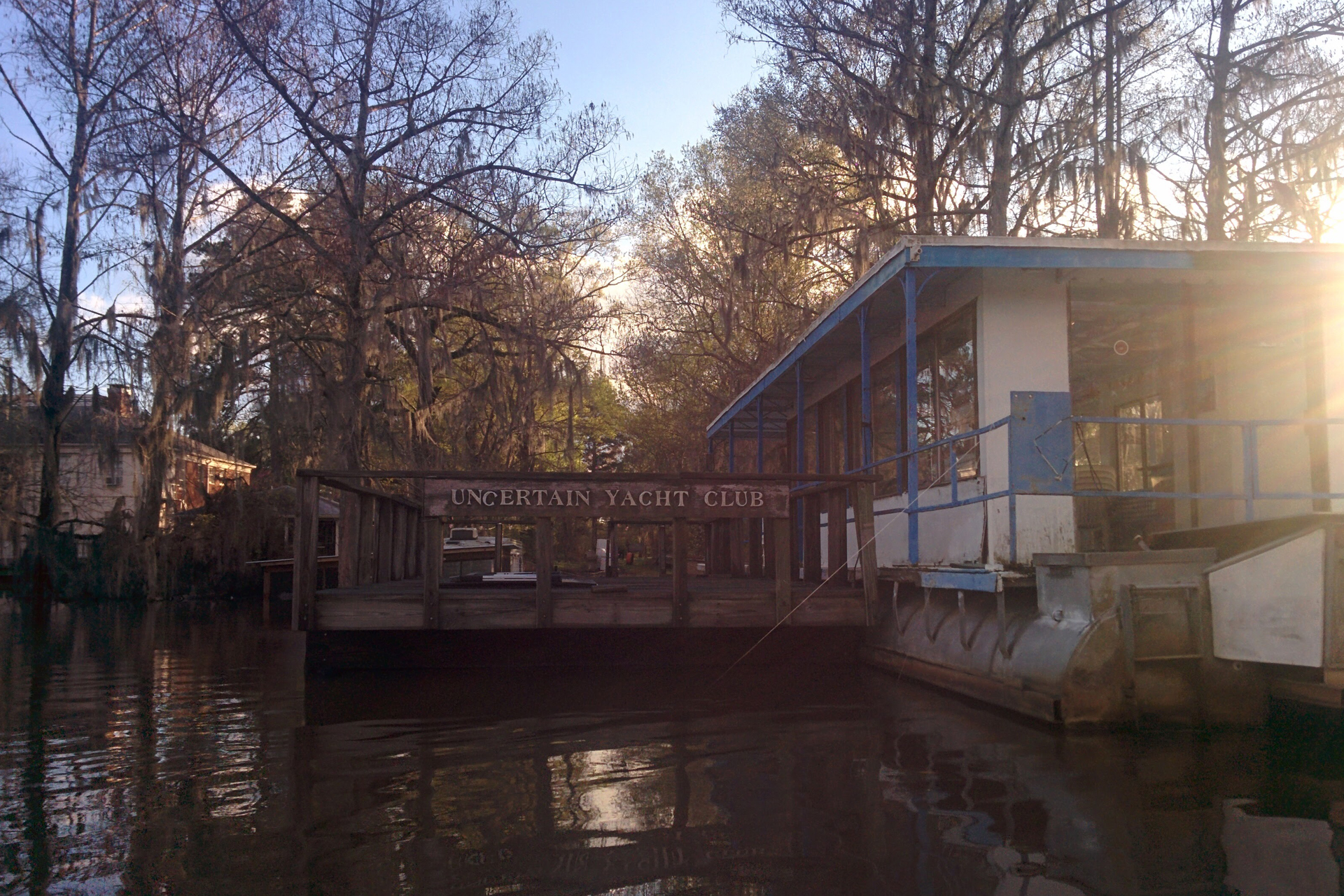
On Easter Sunday, sixteen days after Caddo broke flood stages, the water receded and the dock re-emerged. I steadied each step on the slippery planks and stepped over the muck that landed on the dock as the water fell—dead frogs and snarled up hyacinths and rotting salvania pods. After assessing the merely cosmetic damage, I grabbed the water hose, which was also covered in mud, and began spraying down the dock plank by plank, uncovering the wood grain from the muck. The menial task launched me into introspection about what emerged from this flood and from the experience of writing this story.
Implications
Expanded Notions of Textuality
My storyscape, Immersion, is my translation of the lake. I read the lake. I uncovered the memories and the stories I have of the place, and I used AR to put the live wells, my text, in the lake. In this process of translating the lake to both the AR medium and my virtual reality video, I invented a way of exploring place and medium through immersive narrative. This immersive narrative suggests new ways and new problems of writing and reading place. If I acknowledge that the lake is a text, what kinds of expanded notions of textuality emerge? How does my AR narrative show the ways we construct place with our stories?
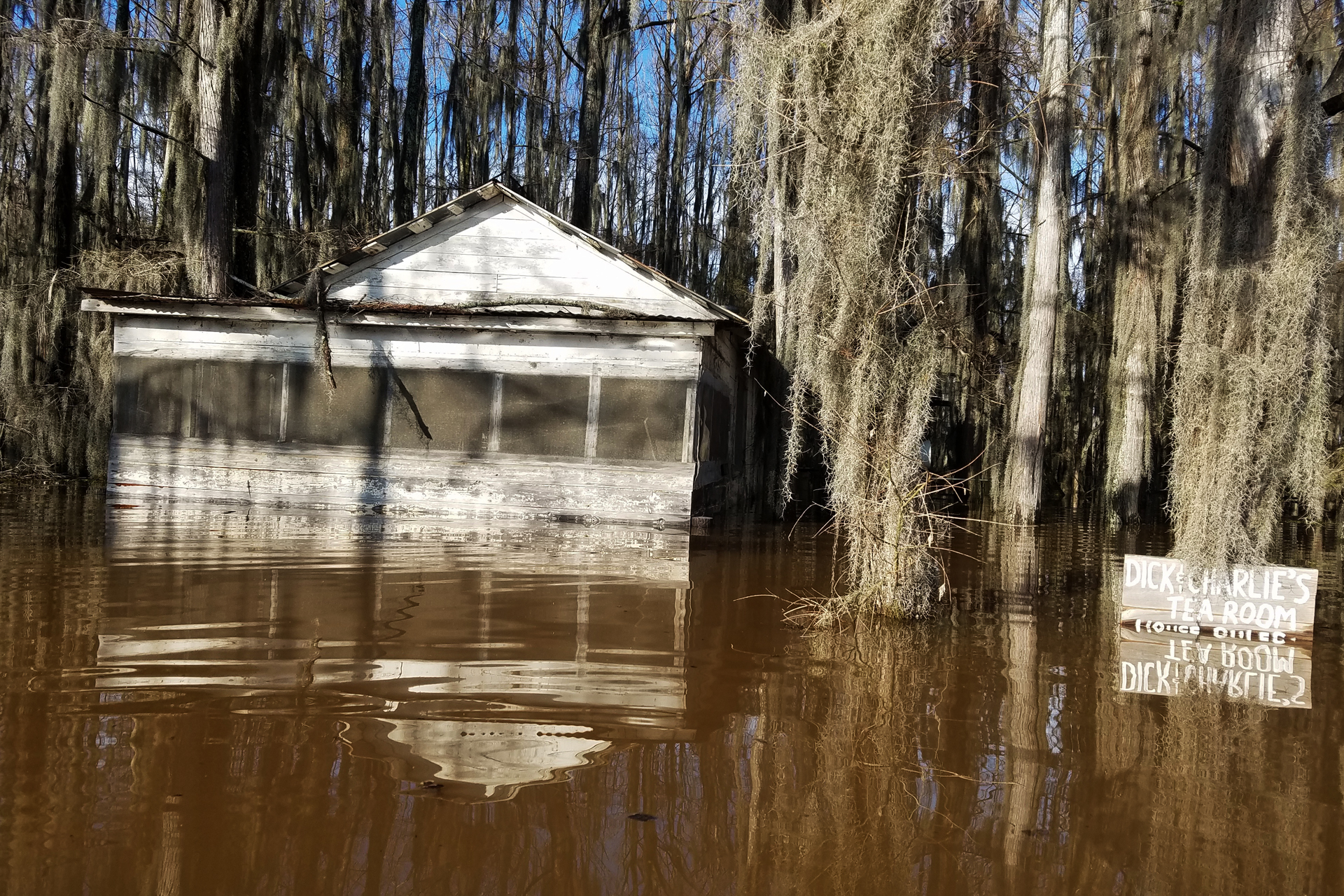
First, my storyscape implies a way of seeing and exploring the rhetoric of a place that expands notions of textuality as purely alphabetic and linear. In my translation, my writing of the lake, I understood that the lake was a text—a text that required literacy to navigate and to interpret.
I know to avoid the cypress knees that hide just below the water; the Game Warden doesn’t make rules about going off the managed and marked boat roads, but the lake makes its own rules by busting my prop if I run over a submerged log. Fellow lake-navigators are kind; they put milk jugs or beer cans on sticks to mark submerged obstacles in the channel.
The writing of my story was informed not only by my position and experience of the place, but also by expanded notions of rhetorical context of the lake. For this, I consider by Thomas Rickert’s notions of ambient rhetoric, which suggest the following:
“Rhetoric can no longer remain centered on its theoretical commonplaces, such as rhetor/subject, audience, language, image, technique, situation, and the appeals accomplishing persuasive work… . Rather, it must diffuse outward to include the material environment, things (including the technological), our own embodiment, and a complex understanding of the ecological relationality as participating in rhetorical practices and their theorization” (Rickerts, 2013, pg. 3).
Rickert’s ambient rhetoric expands the boundaries of Bitzer’s rhetorical situation and Aristotelian appeals to account for the rhetorical agency of the material world, the mediation of technology, and the rhetorical concerns of our embodiment in a place. My story considers these ambient factors by the way the environment affects what the reader/user sees in the interface and in the world around the live wells that becomes part of the textuality.
With regard to the rhetoricity of my “own embodiment” (Rickert, 2013) my act of writing this geographically bound story also explored what my womanness means on Caddo Lake. By placing my words on Caddo Lake, I asserted my belonging in a place where navigation and boating is often gendered. At least once every trip, I am asked, as the man in my story asked, “are you lost?” or experience other comments about my gender and my ability to drive an outboard motor. This cultural immersion shows another aspect of the ambient rhetoric of Caddo Lake.
In short, my story shows one way of making ambient rhetoric more transparent. Augmented reality is a useful metaphor for the way that ambient rhetoric is at work in a place. Writing Immersion afforded me new ways of understanding the role of ambient rhetoric in digital narrative.
With those ambient notions of digital rhetoric, Immersion challenges some of the ideas we typically hold about digital texts and their openness. Immersion adheres to some of the genre conventions of digital narrative in its delivery of a non-linear narrative. As new media scholar Adriana de Souza e Silva also observed in her discussion of location-based mobile narratives like the mixed reality performances of Steve Benford and Gabriella Giannachi, the experience of a geographically bound narrative in a place contrasts the openness of linked hypermedia (de Souza e Silva, 2013; Benford and Giannachi qt. in de Souza e Silva, 2013). Unlike hypertext literature, which invites users to take agency over the reading by choosing to follow links, my live wells are fixed in their geolocation data. The user/reader still affects of the direction of the story, but more through their movement in the place rather than their selection of links.
This agency is disrupted and redistributed in other ways, too. I tend to think of digital texts as open and accessible remotely to anyone with an internet connection. I am ideologically aligned with the Open Access and Open Source movements that note that “shifting from isolated computers to a globe-spanning network of connected computers suddenly allows us to share perfect copies of our work with a worldwide audience at essentially no cost” (Suber, 2012). Yet, in a geographically bound work like Immersion, this access is disrupted. Unlike digital texts that we can access from anywhere, users/readers must experience the narrative in the place.
I may lament the lack of openness—that my committee or my cohort cannot experience the story in the fullness of its medium without buying a plane ticket to Shreveport—but this limitation is crucial to my assertions about place and story. Despite my best attempts at recording, editing, and uploading virtual reality video, the place of Caddo and my story are inseparable. Something of place is always lost in remediation. The “sense of place,” as Keith Basso concludes in Wisdom Sits in Places, is “more an expression of community involvement than of pure geography” (Basso, 1996). My story then pushes against the possibility of total immersion through technology. Even while I look for the inevitable advancement of virtual and augmented reality, writing Immersion caused me to reflect on the limitations of the medium.
Among these limitations, I also wonder about the limitations that affect audience and access not only remotely but also locally. The intended audience for my story is my committee, my cohort, and anyone interested in digital rhetoric and augmented reality. As my reading of Shelley Lang’s thesis and encountering my great-grandfather’s quotation allowed me to see, the audiences we imagine for our academic work aren’t neatly confined (thankfully!) to the academic communities we think we’re writing to.
When we write theses and projects, I don’t imagine we consider that the great-grand-children of the folks we cite will unearth the manuscript for their own amusement or their own research, as I did with Lang’s thesis. It was strange to read I.B.’s words in double-spaced lines in a monospace font in someone else’s three-ring-binder-bound anthropology thesis and not repeated in my grandfather’s warm, theatrical voice in his brown recliner while I sat on the orange carpet next to the brick fireplace in my grandparents’ living room.
Thus audience for academic work about place is complicated. As much as I want my story to be about the place, about inserting myself into a place and becoming part of it, I must accept that my medium is alienating. If I wanted to actually tell a story about a place for the folks there, I’d go to Uncertain, talk with the people out on the dock at Johnson’s Ranch or yell over the outboard motor to my uncles or my cousins while out on a later afternoon boat ride.
The medium suggests that anyone at Caddo who finds the text in the Layar application might experience the story as a tertiary audience. I say this less as a commentary on the technological sophistication of citizens of Uncertain and more as an indication of the non-ubiquitous nature of AR as a medium now.
Whatever the future of AR is, I imagine that more people will access and create stories like Immersion. The expanded notions of textuality like those I discovered in my creation process will allow for greater augmentation of the place with more stories and more ways of experiencing the place for various audiences. While an exhaustive list of potential applications is outside the scope of this reflection, I look forward to the ways that AR will expand our story -making and -telling capabilities. I hope that rhetoric and composition scholars will continue exploring the meaning of this medium and what it shows us about expanded notions of textuality.